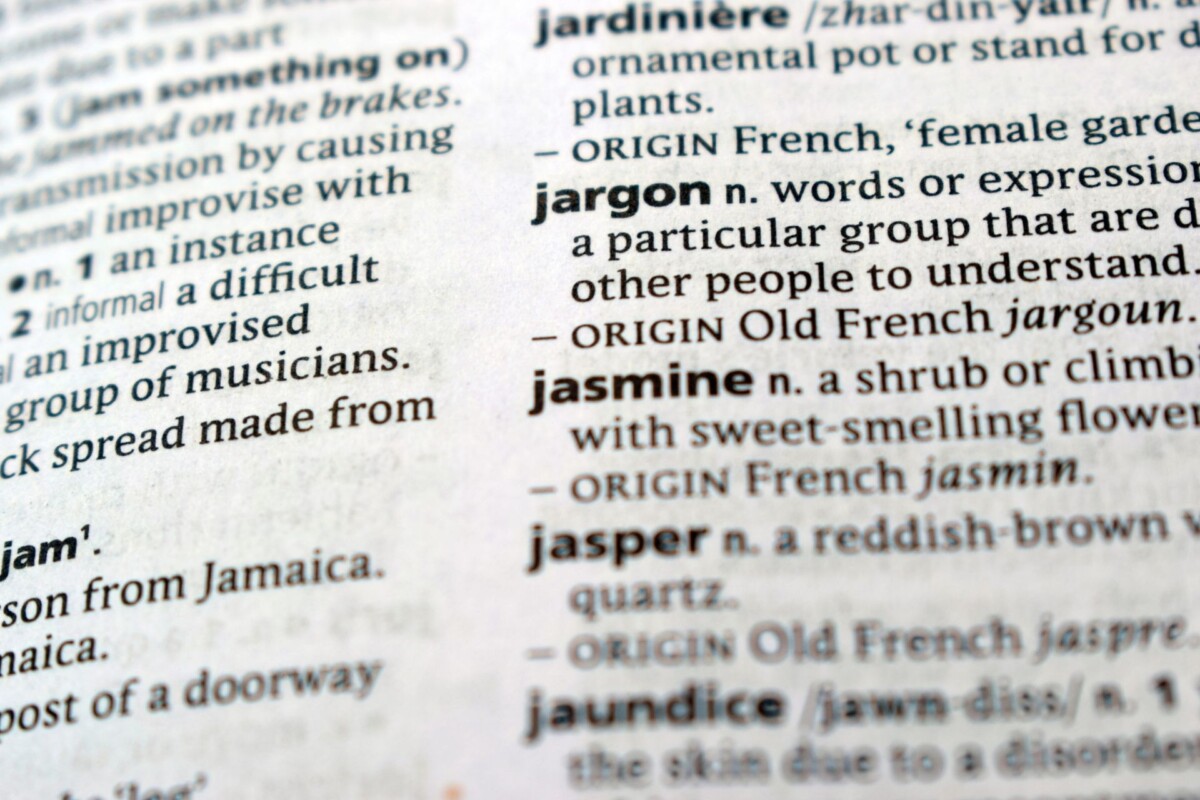

Why do we choose the words nobody understands?
Walk into a bank, a hospital, a courtroom or a car dealership and there’s a fair chance you’ll come out understanding your own situation less well than when you went in. Most of what you were told could have been explained plainly.
It arrived instead in a dialect built for insiders. Amortisation schedule. Chattel mortgage. Third party, fire and theft.
Each phrase does real work for the people who use it every day. For everyone else it’s a locked door.
The usual defence is efficiency. Specialists need shorthand, so the argument runs, because precise terms save time and stop ambiguity between people with the same training.
That holds up in a boardroom or a surgical team. It falls over the moment the same language is pointed at a customer, a patient, a tenant or a voter who has no reason to know the code.
The gap this opens follows income, education and access to advice. Anyone who can afford a lawyer, an accountant or a broker is paying, in part, for translation.
Everyone else decodes it themselves, guesses, or signs anyway and hopes. The customer is rarely the problem. The vocabulary is private and nobody offered them a way in.
Economists have a name for part of this. Information asymmetry describes a situation where one side of a deal knows far more than the other.
Jargon doesn’t cause that imbalance, but it locks it in place when one side has the terminology and the other doesn’t. Every industry builds shorthand.
The trouble starts when the shorthand leaks into customer-facing material and nobody stops to ask whether it belongs there.
The cost shows up first in health. The World Health Organization points out that even people who read well can struggle when they aren’t familiar with medical terms, or with how their own bodies work.
Its advice is that health information should reach people in a form they can understand and act on.
The same concern drives financial regulation. The person on the other side of the counter has to grasp what a product costs and what it risks before they commit to it.
New Zealand has legislated on it. The Plain Language Act 2022 requires public service agencies and Crown agents to take reasonable steps to make their public-facing documents clear, concise, well organised and suited to the audience.
It took effect on 21 April 2023. Agencies have to appoint plain language officers and report to the Public Service Commissioner every year on how they’ve complied.
Regulators ask something similar of business. The Commerce Commission tells traders to explain technical or scientific language and trade terms whenever the average consumer is unlikely to know what they mean.
Under the Financial Markets Conduct Act, a product disclosure statement has to be clear, concise and effective. The Financial Markets Authority’s guidance frames the intended reader as a prudent but non-expert investor.
That last phrase does a lot of work. It credits the reader with care and assumes nothing about what they already know.
Jargon does quieter damage too. Customers who feel talked over rarely stop the meeting to ask for a translation.
They nod, sign where indicated, and work out weeks later that they aren’t sure what they agreed to. By then the signature is what counts, not the understanding behind it.
Which makes clear communication a fairness question rather than a manners one.
Technical language should stay. Some concepts need specific terms, and flattening every idea into casual speech strips out distinctions that matter.
A surgeon briefing another surgeon and the same surgeon briefing a frightened patient are doing two different jobs. The vocabulary should change with the job.
The line worth holding is between vocabulary that serves the listener and vocabulary that serves the speaker’s standing.
A technical term earns its place when it makes something more precise, or faster, for the person on the receiving end. It loses that place the moment its main effect is to make the speaker sound like an expert.
Fixing this is a habit rather than a ban. Define a term the first time it appears. Before publishing, check whether someone outside the field could follow the sentence without a glossary.
Test important documents on people who don’t work in the industry. Treat a confused customer as evidence the explanation failed, rather than evidence about the customer.
Plain language gets accused of talking down. What it does is clear away whatever sits between the information and the person who needs it.
When plain words would do, one question is worth asking first. Who is this language serving?
SPONSORED