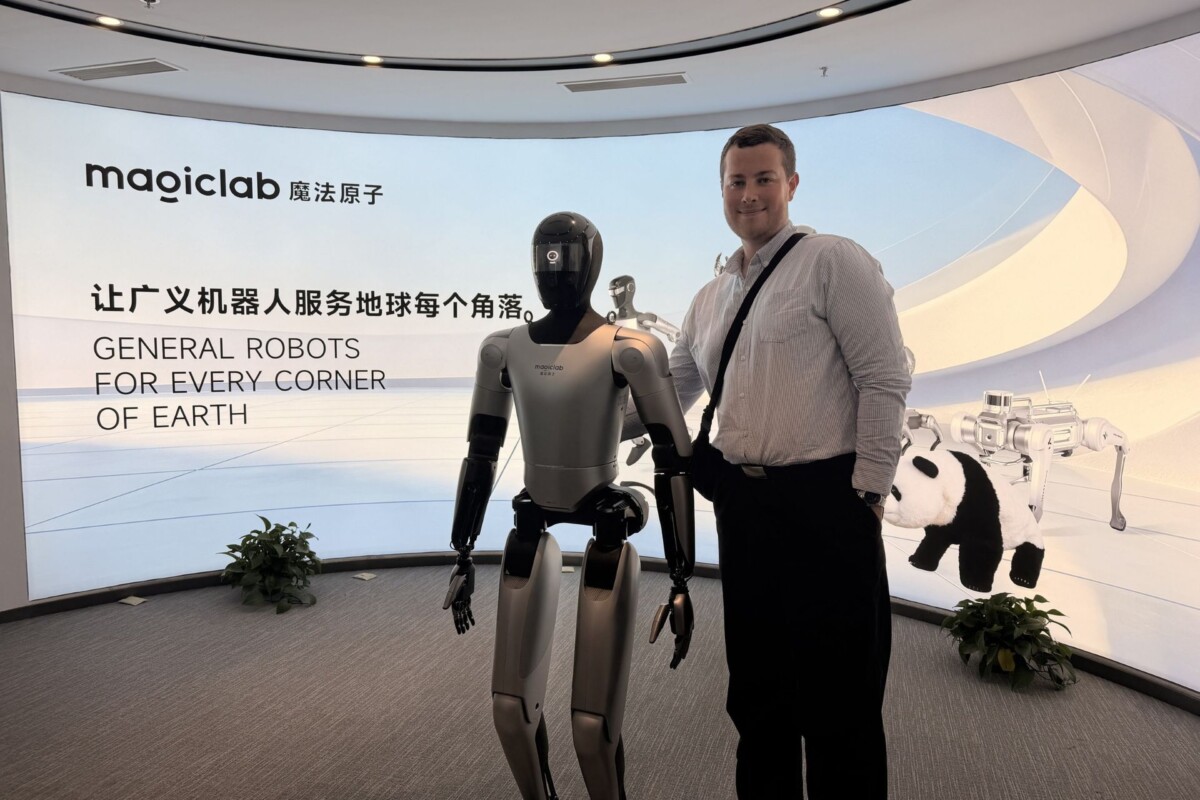

Earlier this year I spent seven days in China with a New Zealand AI delegation, going behind the scenes at companies like Unitree, Baidu and Alibaba. What I found was AI that has stopped being a product and started being infrastructure.
It starts the moment you land. At the Summer Palace, a robot takes your drink order.
In our hotels, the food delivery rider never came upstairs. They handed the order to a robot in the lobby, which called the lift, rode to the right floor and rang the doorbell.
The robots are real, but narrow
The dancing humanoids you see online are a bit gimmicky, although keeping a two-legged robot balanced is genuinely hard engineering. The real work is narrower: moving boxes on a production line, picking medication in a pharmacy, serving coffee in a convenience store.
Every robotics company told us the same thing. The hard problem isn’t the body, it’s data.
Robots trained in simulation struggle in the messy real world, so companies are paying people to film themselves doing chores with cameras strapped to their heads. Real-world data is now the most valuable asset in robotics.
Speed is the new advantage
China’s old edge was cheap manufacturing. The new one is iteration speed.
Appliance maker Dreame runs more than 200 businesses in its ecosystem, from a fridge that adjusts to the vegetables inside to a stair-climbing vacuum. In some areas two internal teams compete on the same product, and the one that misses its targets is gone.
National direction drives it. The new five-year plan mentions AI more than 50 times, up from about six, with a target of 90% adoption across key sectors by 2030.
At China Construction Bank, staff have built more than 400 internal AI agents and share them on a marketplace. The tools colleagues use spread. The rest quietly die.
Scale that is hard to picture
One Beijing hospital serves around five million patients a year, roughly the population of New Zealand. Patients are triaged by an AI agent, AI has cut scan interpretation time by 80%, and a robot picks prescriptions at the pharmacy. Baidu runs AI-generated live shopping hosts that sell just as well as humans, even when labelled as AI.
The humans still matter
The most telling story was a failure. Alibaba tried to generate fashion designs end to end with AI.
The results were soulless and nobody trusted them, so they rebuilt it to feed trend research to human designers instead. Across the whole trip, what failed was removing human judgment, not using too little AI.
China isn’t a model to copy wholesale. But anyone who still thinks of AI as a chatbot in another tab should see what it looks like when a whole country wires it into daily life.
Blake Harkness is an AI engineer and the founder of Harkness AI, a Christchurch consultancy helping New Zealand businesses put AI to work. harknessai.nz
SPONSORED